Product Overview
What Is a Type 3B Chemical Protective Coverall?
A Type 3B chemical protective coverall is designed to provide protection against hazardous liquid chemicals under pressure while helping reduce exposure to contaminated particles and biological agents.
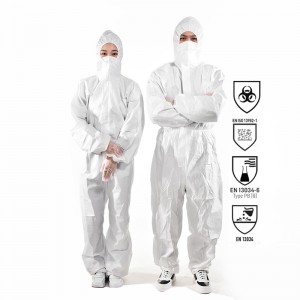
This disposable full-body coverall combines a PP nonwoven substrate with an external PE laminated barrier layer, creating a durable protective garment suitable for demanding industrial environments.
The garment features fully taped seams, an attached hood and a double zipper storm flap system to enhance barrier performance and reduce potential ingress points.

Technical Specifications
| Item | Specification |
|---|---|
| Product Name | Chemical Protective Coverall |
| Material | PP + PE Laminated Fabric |
| Fabric Weight | 87gsm |
| Design | Full-Body Laminated Protective Coverall |
| Hood | Attached Hood |
| Closure | Double Zipper Closure with Storm Flap |
| Seams | Fully Taped Seams |
| Boot Cover | Without Boot Cover |
| Color | Yellow |
| Usage | Single Use |

Key Features
87gsm PP + PE Laminated Fabric
The coverall utilizes a multilayer protective structure:
Outer PE Barrier Layer
Provides resistance against:
- 1.Chemical splashes
- 2.Liquid penetration
- 3.Oils and contaminants
- 4.Decontamination chemicals
Inner PP Nonwoven Layer
Provides:
- 1.Lightweight comfort
- 2.Improved breathability
- 3.Enhanced wearer mobility


Fully Taped Seams
All seam lines are covered with chemical-resistant sealing tape.
Benefits include:
- 1.Reduced liquid penetration through stitched areas
- 2.Improved barrier integrity
- 3.Enhanced performance in contaminated environments
- 4.Increased durability during demanding tasks
Double Zipper Closure with Storm Flap
The front opening features:
- 1.Heavy-duty double zipper design
- 2.Protective storm flap
- 3.Sealed front closure system
This design helps strengthen protection in one of the most vulnerable areas of protective clothing.
Attached Hood Design
The integrated hood is designed for use with:
- 1.Respirators
- 2.Face shields
- 3.Safety goggles
- 4.Industrial PPE systems
Helping provide comprehensive head and neck coverage.


Understanding the Protection Standards
EN 14605 Type 3B
Protection against pressurized liquid chemicals.
Commonly required for:
- Chemical manufacturing
- Hazardous liquid transfer
- Industrial decontamination
EN 14605 Type 4B
Protection against liquid spray and aerosol exposure.
Suitable for:
- 1.Disinfection operations
- 2.Agricultural spraying
- 3.Industrial sanitation
EN ISO 13982-1 Type 5B
Protection against airborne hazardous particles.
Applications include:
- 1.Powder handling
- 2.Industrial dust environments
- 3.Hazardous particulate exposure
EN 1149-5 Anti-Static Protection
Helps dissipate electrostatic charges.
Recommended for:
- 1.Petrochemical facilities
- 2.Electronic manufacturing
- 3.Flammable environments
EN 13034 Type 6B
Protection against limited liquid chemical splashes.
Suitable for lower-risk chemical exposure situations.

EN 1073-2 Radioactive Contamination Protection
Provides protection against radioactive particulate contamination.
Applicable to:
- 1.Nuclear maintenance operations
- 2.Radioactive contamination control
- 3.Specialized industrial environments
EN 14126 Protection Against Infective Agents
Provides performance requirements for protective clothing used in environments where exposure to biological hazards may occur.
Commonly used in:
- 1.Decontamination operations
- 2.Biohazard response
- 3.Infection control procedures
Recommended Applications
Chemical Industry
- Chemical processing
- Acid and alkali handling
- Industrial maintenance
Nuclear and Specialized Industries
- Radioactive contamination control
- Maintenance activities
- Industrial inspection work
Hazardous Waste Management
- Waste collection
- Site remediation
- Contaminated material handling
Environmental Decontamination
- Industrial sanitation
- Public area disinfection
- Emergency response
Oil & Gas Industry
- Refinery maintenance
- Petrochemical operations
- Tank cleaning
Pharmaceutical & Laboratory Operations
- Chemical laboratories
- Research facilities
- Controlled environments


FAQ
1.What is the difference between Type 3B and Type 4B protective clothing?
Type 3B is designed for protection against pressurized liquid chemicals, while Type 4B is intended for liquid spray and aerosol exposure.
2.Why are taped seams important?
Taped seams cover stitched areas and help maintain barrier integrity by reducing potential penetration points.
3.Does this coverall provide anti-static protection?
Yes. The garment complies with EN 1149-5 requirements for electrostatic dissipative protective clothing.
4.Is this coverall suitable for biological contamination environments?
The product complies with EN 14126 requirements relating to protection against infective agents.
5.Can it be used in radioactive contamination control applications?
The coverall complies with EN 1073-2 requirements concerning protection against radioactive particulate contamination.