Wet wipes have become an essential part of modern personal care and household cleaning. From baby wipes and facial cleansing wipes to disinfectant wipes and moist toilet tissue, these products offer convenience and effective cleaning for everyday use.
However, there is one common mistake that many consumers make: flushing wet wipes down the toilet.
Although some wet wipes are marketed as flushable, many conventional wipes are not designed to break apart like toilet paper. When they enter drainage pipes and wastewater systems, they can accumulate, become entangled with other materials, and contribute to blockages and costly maintenance problems.
So, why shouldn’t you flush wet wipes? What happens after they enter the sewer system? And are flushable wipes really safe to flush?
In this article, we explore the science behind wet wipe disposal, explain the differences between conventional and flushable wipes, and discuss how material composition affects product performance and wastewater compatibility.
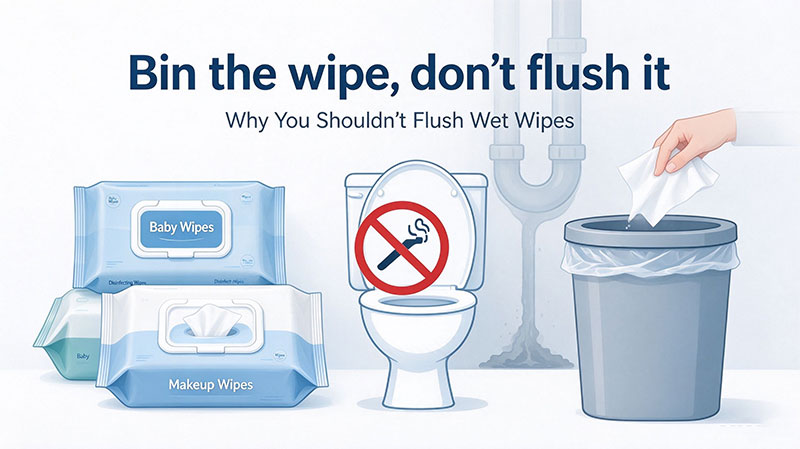
1. Why Shouldn’t You Flush Wet Wipes?
The main reason you shouldn’t flush conventional wet wipes is that they are designed to remain strong when wet.
Unlike toilet paper, which is specifically manufactured to break apart during flushing, most wet wipes use nonwoven structures that maintain their integrity during cleaning.
This strength is useful when wiping skin, cleaning surfaces, or removing dirt. However, it can become a problem when the used wipe enters a plumbing or sewer system.
Wet Wipes vs. Toilet Paper
| Comparison Factor | Toilet Paper | Conventional Wet Wipes |
|---|---|---|
| Main purpose | Personal hygiene after using the toilet | Baby care, facial cleansing, household cleaning, and personal care |
| Material structure | Paper fibers designed to disperse in water | Nonwoven fiber networks designed to retain strength |
| Wet strength | Generally decreases during contact with water | Usually designed to remain strong when wet |
| Disintegration | Designed to break apart during normal flushing | May remain intact for extended periods |
| Sewer compatibility | Generally suitable when used in normal quantities | Not designed for flushing in most cases |
| Disposal method | Toilet flushing | Household trash |
The difference is not simply about thickness. A thin wet wipe may still have a strong fiber network that prevents it from breaking apart easily in water.
For this reason, baby wipes, makeup wipes, cleaning wipes, and other conventional wet wipes should be disposed of in household waste rather than flushed down the toilet.
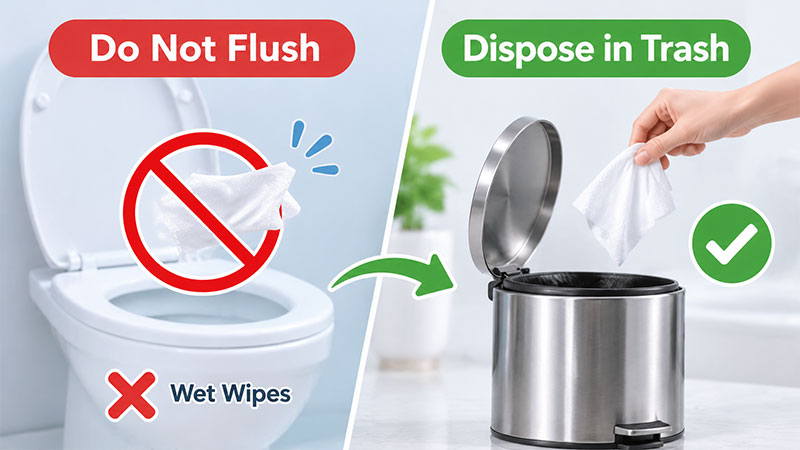
2. What Happens When You Flush Wet Wipes?
Flushing a wet wipe may seem harmless because it disappears from the toilet bowl. However, the toilet is only the beginning of the wastewater journey.
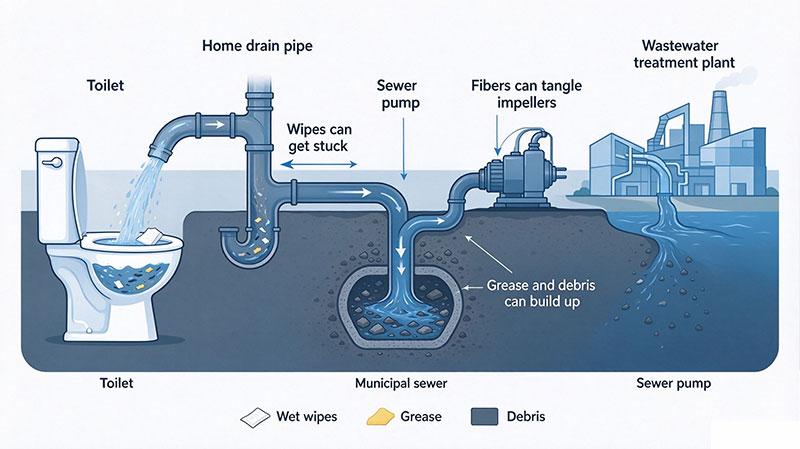
After flushing, the wipe travels through household drainage pipes and may eventually enter a municipal sewer network or an on-site wastewater treatment system.
If the wipe does not disperse sufficiently, it can create problems at several stages.
2.1 Wet Wipes Can Get Stuck in Household Pipes
Household drainage systems contain pipe bends, joints, and surfaces where solid materials can become trapped.
Wet wipes may catch on existing obstructions, combine with grease, or accumulate with other waste materials.
Over time, this can contribute to:
- Slow-draining toilets and pipes.
- Repeated plumbing blockages.
- Wastewater backing up into bathrooms.
- Expensive professional plumbing repairs.
Older plumbing systems or pipes with existing obstructions may be particularly vulnerable.
2.2 Wet Wipes Can Damage Wastewater Pumps
Once wipes enter municipal sewer networks, they may encounter pumps that move wastewater through the system.
Unlike toilet paper, conventional wipes may retain their shape and become tangled around pump components.
| Wastewater System Component | Potential Problem Caused by Wet Wipes | Possible Result |
|---|---|---|
| Household drainage pipes | Wipes become trapped at bends or obstructions | Slow drainage or blockages |
| Sewer pipelines | Wipes accumulate with grease and other debris | Restricted wastewater flow |
| Pump impellers | Wipes wrap around rotating components | Reduced pump efficiency or equipment failure |
| Protective screens | Fibrous materials collect on screening equipment | More frequent cleaning and maintenance |
| Wastewater treatment facilities | Non-dispersed solids enter the treatment process | Additional screening and solid waste handling |
The International Water Services Flushability Group (IWSFG) identifies snagging, roping, and clogging as important concerns when evaluating materials entering wastewater systems.
2.3 Wet Wipes Can Contribute to Fatbergs
One of the most widely discussed consequences of improper wet wipe disposal is the formation of fatbergs.
A fatberg is a large mass of accumulated material in sewer systems. It can contain fats, oils, grease, wet wipes, and other materials that do not break down easily.
Wet wipes can become entangled with grease and other debris, creating dense accumulations that restrict wastewater flow.
| Contributing Material | Role in Fatberg Formation |
|---|---|
| Wet wipes | Provide fibrous material that can become entangled with other waste |
| Cooking grease | Cools and solidifies, helping bind materials together |
| Paper towels | Can retain their structure and contribute to accumulated solids |
| Sanitary products | Add materials that are not designed to disperse in sewer systems |
| Other non-flushable waste | Increases the amount of material accumulating in pipes |
Fatbergs can be difficult and expensive to remove. Their presence may also increase the risk of sewer blockages and wastewater overflows.
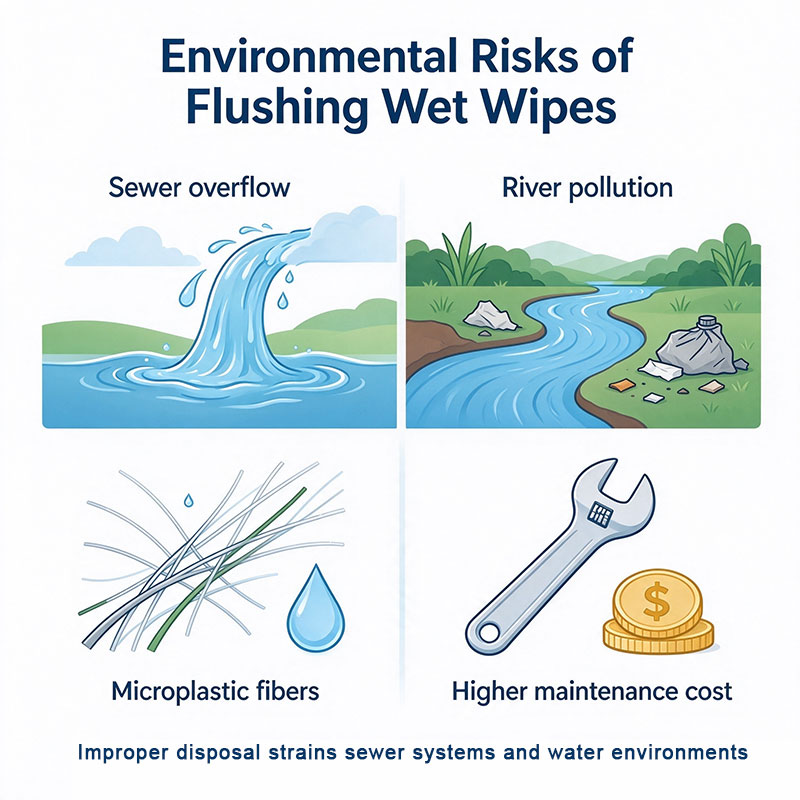
3. What Are the Environmental Consequences of Flushing Wet Wipes?
Improper wet wipe disposal is not only a plumbing issue. It can also create environmental and wastewater management challenges.
When non-dispersible wipes accumulate in sewer systems, wastewater operators may need additional maintenance and cleaning. In severe cases, blockages can contribute to sewage overflows.
Key Environmental Concerns
| Environmental Issue | How Wet Wipes Contribute | Potential Impact |
|---|---|---|
| Sewer overflows | Accumulated wipes restrict wastewater flow | Untreated wastewater may enter the environment |
| Water pollution | Wastewater overflows can carry contaminants into waterways | Reduced water quality |
| Plastic pollution | Some wipes contain synthetic fibers | Persistent plastic materials may enter the environment |
| Increased landfill waste | Removed wipes and screening residues require disposal | More solid waste management |
| Higher energy and maintenance demands | Blockages require equipment cleaning and repairs | Additional wastewater system operating costs |
It is important to distinguish between different wet wipe materials.
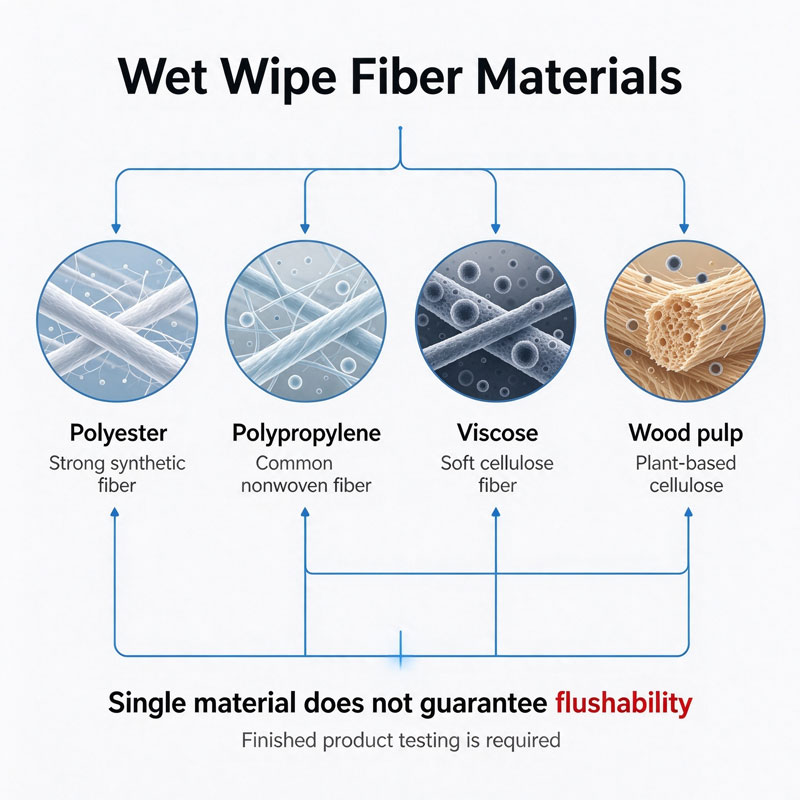
Some products contain polyester or polypropylene fibers, while others use cellulose-based materials such as wood pulp or viscose.
The environmental behavior of these materials differs, but using plant-derived fibers does not automatically make a product suitable for flushing.
The complete product structure and disposal conditions matter.
4. Are Flushable Wet Wipes Really Flushable?
This is one of the most common questions about wet wipe disposal.
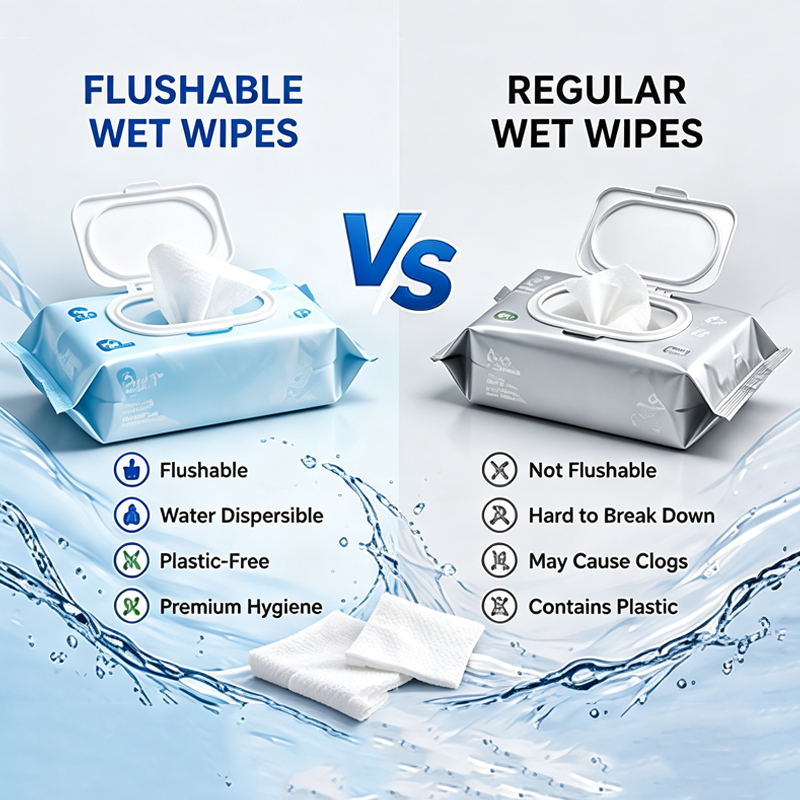
The word “flushable” refers to products designed and evaluated against relevant flushability performance criteria. It does not mean that a wipe completely dissolves in water or is guaranteed to work safely in every plumbing and wastewater system.
Some wastewater authorities, including New York City’s Department of Environmental Protection and Seattle Public Utilities, recommend flushing only human waste and toilet paper, and placing all wipes in the trash, even when the packaging says flushable.
Flushable Wet Wipes vs. Regular Wet Wipes
| Feature | Flushable Wet Wipes | Regular Wet Wipes |
|---|---|---|
| Design objective | Balance cleaning performance with flushability-related requirements | Maintain performance for the intended cleaning application |
| Substrate selection | Developed for specific flushability performance targets | May use durable synthetic or composite nonwoven materials |
| Fiber structure | Engineered to support appropriate dispersibility | Often designed to retain strength during use |
| Testing | Evaluated against relevant flushability criteria | Application-specific quality and performance testing |
| Typical applications | Wet toilet tissue and selected bathroom hygiene products | Baby care, facial cleansing, household cleaning, and pet care |
| Disposal instructions | Depend on the product and local wastewater recommendations | Generally household trash |
What Does Flushability Testing Evaluate?
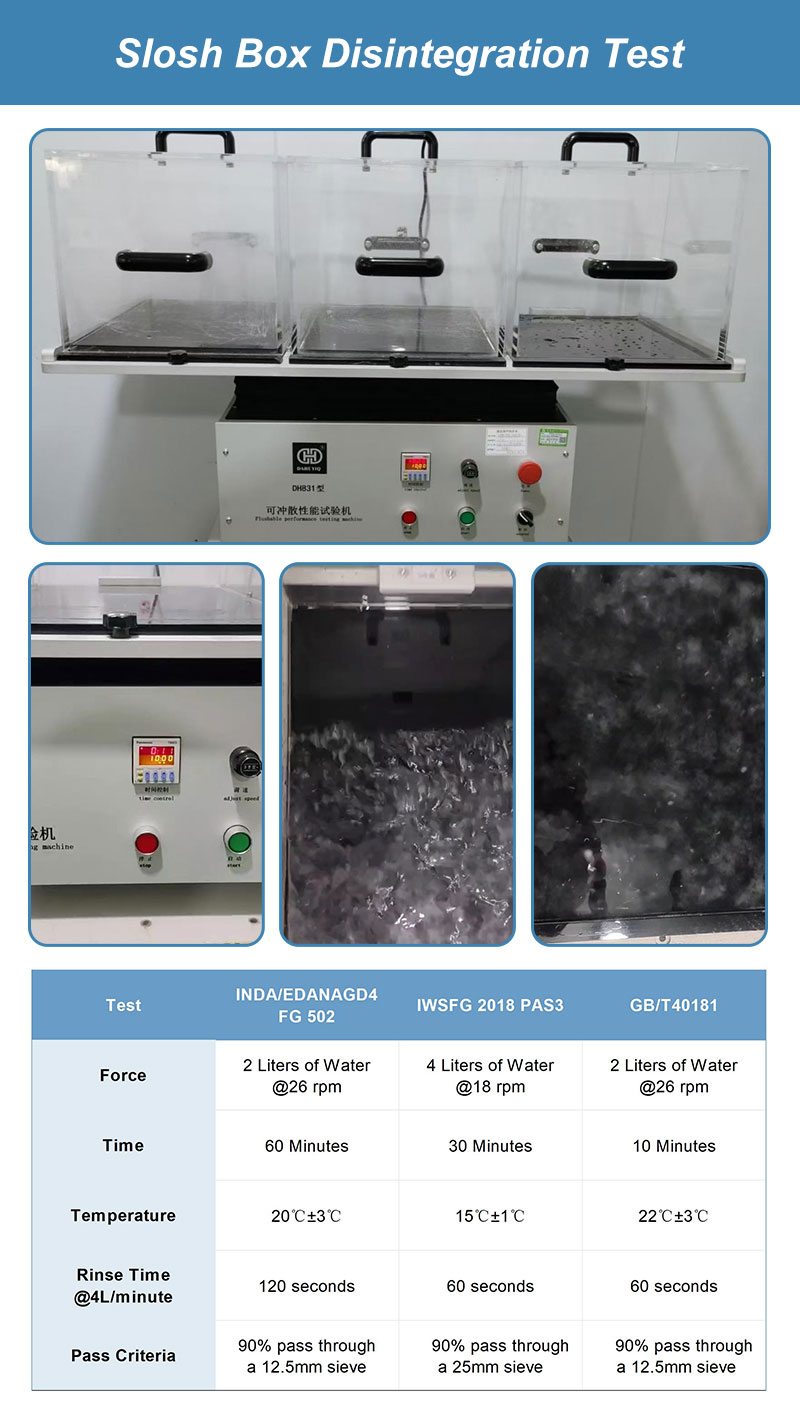
Flushability is not determined by simply placing a wipe in a glass of water and observing whether it breaks apart.
Recognized industry and wastewater-related frameworks consider several performance aspects.
| Testing Area | What It Evaluates |
|---|---|
| Toilet and drainline clearance | Whether the product can pass through specified toilet and drainage test conditions |
| Disintegration | Whether the material breaks into smaller pieces under defined conditions |
| Settling | How the material behaves in water and wastewater environments |
| Biodisintegration | How the material behaves during biological treatment-related evaluation |
| Environmental protection | Whether the product meets relevant criteria designed to protect wastewater infrastructure and the environment |
IWSFG publishes specifications that include criteria for flushability assessment. Buyers and manufacturers should consult the applicable current documents and verify which criteria are relevant to their products.
A flushability test report should always be checked against the exact product specification, including material construction and finished-wipe characteristics.
Important: Even when a product meets applicable flushability criteria, consumers should follow local wastewater authority recommendations. Some municipalities still advise against flushing all wipes.
5. Does Wet Wipe Material Affect Whether It Can Be Flushed?
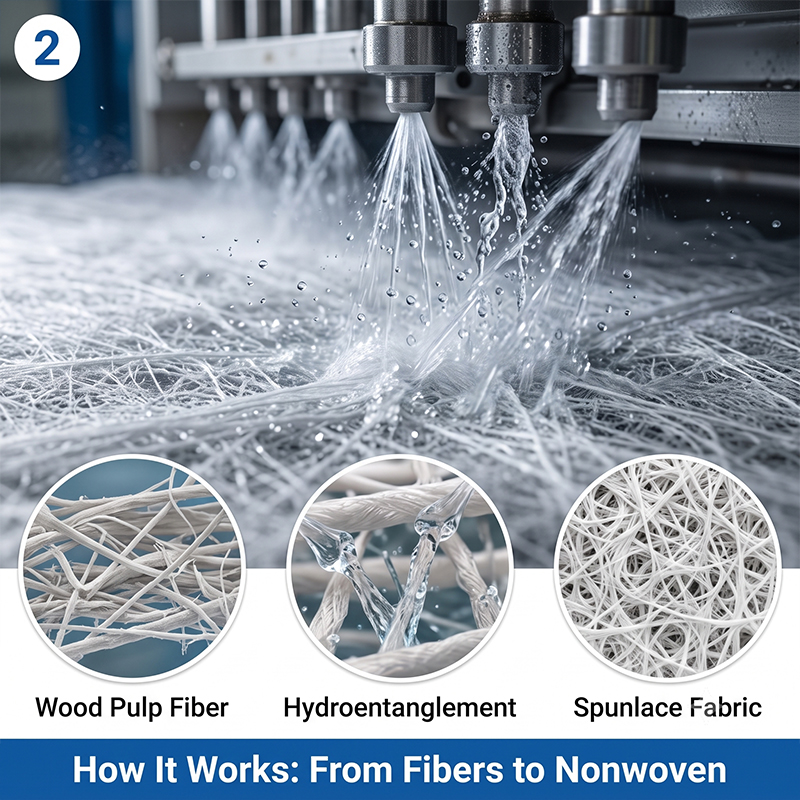
Yes. Material composition and nonwoven structure play an important role in how a wet wipe behaves during use and under flushability-related testing.
Different fibers provide different levels of wet strength, softness, absorbency, and structural integrity.
Common Wet Wipe Materials and Their Characteristics
| Material | Main Properties | Common Applications | Flushability Considerations |
|---|---|---|---|
| Polyester | Strong, durable, and resistant to wet handling | Industrial cleaning and household wipes | Conventional polyester-based constructions are generally not intended for flushing |
| Polypropylene (PP) | Lightweight and cost-effective | General-purpose cleaning wipes | Finished construction requires evaluation; ordinary PP wipes should not be flushed |
| Viscose | Soft and absorbent, made from regenerated cellulose | Personal care and hygiene wipes | Can be considered in suitable product designs, but fiber type alone does not prove flushability |
| Wood Pulp | Cellulose-based with good absorbency | Cleaning and specialty hygiene wipes | May be used in dispersible nonwoven development, subject to finished-product testing |
| Polyester + Wood Pulp | Combines strength and absorbency characteristics | Industrial and specialty wiping materials | Generally requires application-specific disposal guidance and testing |
| Cellulose-Based Composite | Can be engineered for selected product performance requirements | Selected wet toilet tissue products | Requires evaluation of the complete finished product |
Why Does Material Structure Matter?
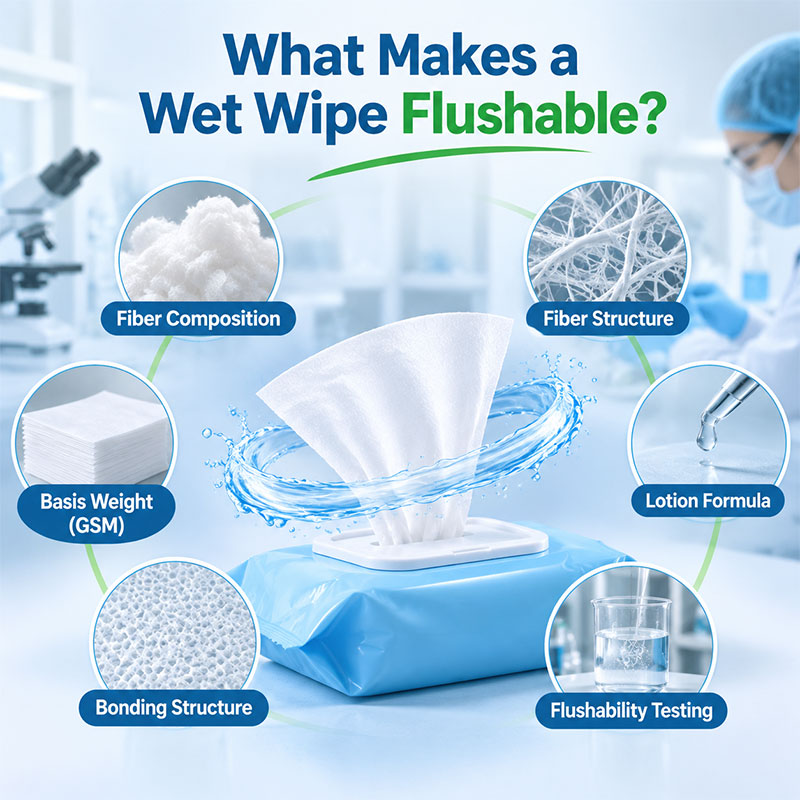
The performance of a wet wipe depends on more than its raw material.
Several factors can influence the behavior of a finished wipe:
- Fiber composition: Different fibers provide different mechanical and absorbency characteristics.
- Fiber length: Influences the structure and strength of the nonwoven web.
- Bonding method: Determines how fibers are connected within the substrate.
- Basis weight (GSM): Affects material thickness, handling, and overall performance.
- Lotion formulation: Influences moisture content and product characteristics.
- Manufacturing process: Affects consistency and the structure of the finished material.
For example, a wipe containing wood pulp is not automatically flushable. Similarly, a lightweight wipe is not necessarily more dispersible than a heavier one.
The complete substrate and finished product must be evaluated against the intended performance requirements.
6. What Should You Do Instead of Flushing Wet Wipes?
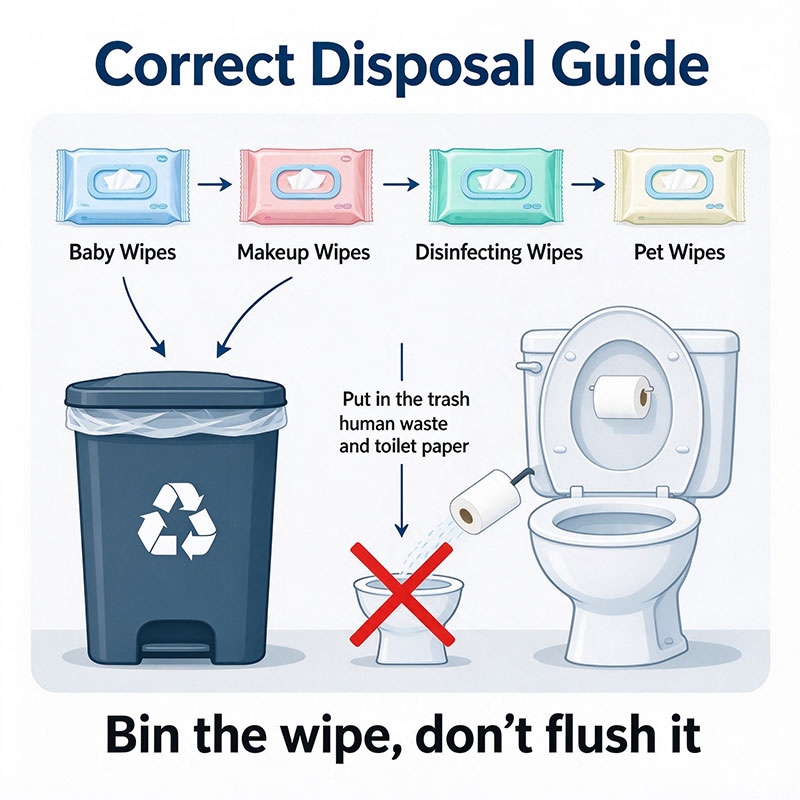
The simplest way to avoid plumbing problems is to dispose of conventional wet wipes in household waste.
Here are some practical recommendations.
| Wet Wipe Type | Recommended Disposal |
|---|---|
| Baby wipes | Place in a lined household waste bin |
| Makeup remover wipes | Place in household waste |
| Facial cleansing wipes | Place in household waste |
| Disinfectant wipes | Follow product label instructions and applicable waste requirements |
| Household cleaning wipes | Place in household waste unless specialized disposal is required |
| Pet wipes | Place in household waste |
| Industrial cleaning wipes | Follow workplace waste procedures, especially if contaminated with chemicals or hazardous substances |
| Wet toilet tissue labeled flushable | Follow local wastewater authority guidance and product instructions |
Simple Habits for Responsible Disposal
- Keep a covered waste bin in the bathroom.
- Avoid flushing conventional baby, facial, and cleaning wipes.
- Read product packaging before disposal.
- Follow local wastewater authority recommendations.
- Do not assume biodegradable or plant-based wipes are automatically flushable.
- Dispose of chemically contaminated wipes according to relevant safety instructions.
These small habits can help protect household plumbing and reduce unnecessary waste management problems.
7. How Can Wet Wipe Manufacturers Help Reduce Disposal Problems?
Manufacturers play an important role in improving product design and helping consumers understand how different wet wipes should be disposed of.
Product development should consider material composition, intended application, product performance, and the disposal instructions appropriate to the target market.
Key Considerations for Wet Wipe Manufacturers
| Development Area | What Manufacturers Should Consider | Why It Matters |
|---|---|---|
| Raw material selection | Polyester, polypropylene, viscose, wood pulp, and suitable fiber blends | Determines key substrate characteristics |
| Nonwoven structure | Fiber arrangement and bonding method | Influences wet strength and material behavior |
| GSM customization | Basis weight based on intended application | Helps balance thickness, strength, and absorbency |
| Lotion formulation | Moisture level and ingredient compatibility | Supports product quality and stability |
| Finished-product testing | Relevant physical, microbiological, and flushability-related tests | Helps substantiate product performance |
| Packaging and labeling | Accurate use instructions and disposal guidance | Helps consumers make informed decisions |
| Quality control | Consistent production specifications | Reduces variations between product batches |
For brands developing flushable wet wipes, it is particularly important to verify the complete finished product rather than relying only on the characteristics of individual raw materials.
Clear labeling also helps prevent consumers from confusing conventional wet wipes with products specifically developed for flushability-related applications.
8. Frequently Asked Questions About Flushing Wet Wipes
1. Why shouldn’t you flush wet wipes down the toilet?
Most conventional wet wipes are designed to maintain their structure when wet. Unlike toilet paper, they may not break apart quickly enough and can contribute to blockages in household pipes, sewer networks, and wastewater pumps.
2. Can one wet wipe clog a toilet?
One wipe does not necessarily cause an immediate blockage, but it can become trapped in an existing obstruction or combine with other debris. Repeated flushing increases the risk of accumulation.
3. Are flushable wipes safe to flush?
Some wipes are designed and tested against recognized flushability criteria. However, not all wastewater authorities recommend flushing them. Always follow local guidance and product instructions.
4. Do wet wipes dissolve in water?
Most conventional wet wipes do not dissolve like toilet paper. Some specialized wipes are designed to disperse under defined test conditions, but dispersibility is different from complete dissolution.
5. Why do wet wipes clog sewer pipes?
Wet wipes can catch on pipe irregularities, become tangled with other waste, and combine with grease. They may also wrap around wastewater pump components and interfere with normal operation.
6. Are biodegradable wet wipes safe to flush?
Not necessarily. Biodegradability and flushability are different properties. A biodegradable wipe may still retain its structure during flushing and cause plumbing problems.
7. What is a fatberg?
A fatberg is a large accumulation of fats, oils, grease, wipes, and other solid waste in sewer systems. These masses can restrict wastewater flow and require costly removal.
8. Can baby wipes be flushed if they are labeled disposable?
No. Disposable does not mean flushable. Most baby wipes should be placed in household waste.
9. What should I flush down the toilet?
Many wastewater authorities recommend flushing only human waste and toilet paper. Other items, including wet wipes, paper towels, and hygiene products, should be disposed of in the trash.
10. How can buyers identify a reliable flushable wet wipes manufacturer?
Buyers should request detailed material specifications, relevant finished-product test reports, product samples, quality control documentation, and evidence supporting the intended flushability claims.
9. Final Thoughts: Think Before You Flush
Wet wipes are designed to make everyday cleaning easier, but their convenience should not lead to improper disposal.
Most conventional wet wipes are not designed to break apart like toilet paper. When flushed, they can accumulate in pipes, contribute to fatbergs, interfere with wastewater pumps, and increase maintenance costs.
The best general practice is simple: flush only human waste and toilet paper unless local wastewater guidance explicitly allows other products. Put conventional wet wipes in the trash.
For wet wipes manufacturers and private label brands, responsible product development means understanding the relationship between fiber composition, nonwoven structure, product performance, and disposal requirements.
By combining appropriate material selection, finished-product testing, clear labeling, and consumer education, the wet wipes industry can support better product quality and more responsible disposal practices.
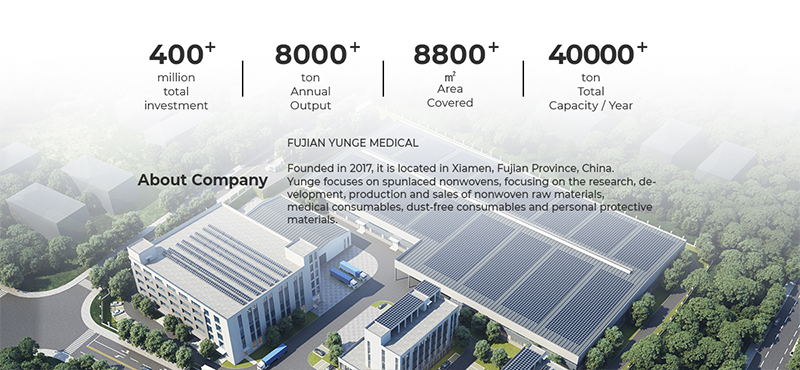
Looking for a professional wet wipes and nonwoven manufacturer? Explore material options, customized product specifications, and OEM/ODM solutions for different personal care, household, and industrial wiping applications.
Post time: Oct-29-2026