Wet wipes are widely used for baby care, personal hygiene, facial cleansing, household cleaning, and bathroom care. They are convenient, portable, and available in many different materials and formulations. However, one common question remains: Can you flush wet wipes down the toilet, or should they always go in the trash?
The answer depends on the type of wipe, its intended use, the evidence supporting its flushability claims, and local wastewater guidance. Many conventional wet wipes are not designed to disperse in sewer systems, while some products are specifically developed and tested for flushability-related performance. Even so, certain wastewater authorities recommend putting all wet wipes in the trash, including products labeled “flushable.”
Knowing how to dispose of wet wipes correctly can help reduce plumbing problems, avoid unnecessary maintenance costs, and support better wastewater management.
In this guide, we compare different types of wet wipes, explain why they can cause sewer blockages, and outline what consumers, retailers, and wet wipes manufacturers should know about responsible disposal.
1. Can You Flush Wet Wipes Down the Toilet?
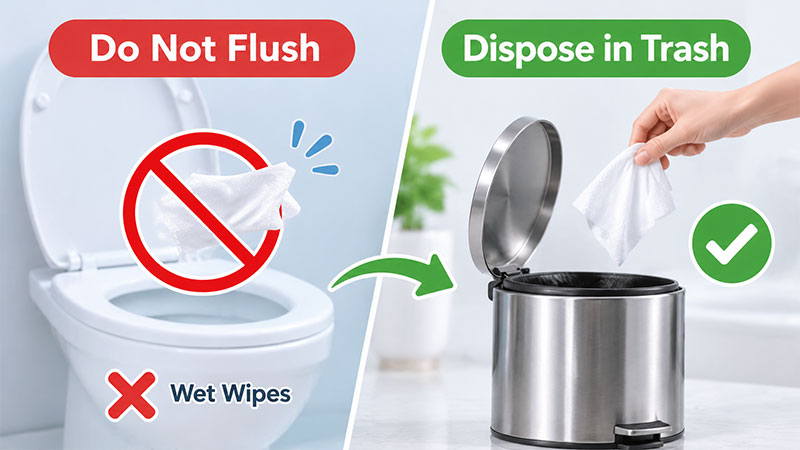
As a general rule, do not flush wet wipes unless the product instructions and local wastewater guidance explicitly allow it. Many wastewater authorities recommend flushing only human waste and toilet paper, regardless of whether a wipe is labeled flushable.
Wet wipes are engineered to remain intact while being handled and used. Unlike conventional toilet paper, many wipes do not break apart quickly enough under the conditions found in household plumbing and sewer systems.
The important distinction is between a wipe that can physically pass through a toilet and one that has demonstrated appropriate dispersibility under defined test conditions. A wipe passing through the toilet bowl does not prove that it will travel through the entire drainage system without causing problems.
| Product or material | Should you flush it? | Recommended disposal |
|---|---|---|
| Conventional baby wipes | No | Place in household waste |
| Makeup remover wipes | No | Place in household waste |
| Facial cleansing wipes | No | Place in household waste |
| Household cleaning wipes | No | Place in household waste |
| Disinfectant wipes | No | Follow the label and local waste instructions |
| Pet grooming and paw wipes | No | Place in household waste after use |
| Feminine hygiene wipes | Follow local guidance; many authorities advise against flushing | Household waste is the safer general choice |
| Wet toilet tissue labeled flushable | Only if permitted by the product instructions and local wastewater authority | Otherwise, place in household waste |
| Dry toilet paper | Generally yes | Flush in normal quantities, subject to local guidance |
Important: This table provides general disposal guidance, not a universal legal rule. Local wastewater authorities may prohibit flushing every type of wipe, including products marketed as flushable.

2. Why Shouldn’t You Flush All Wet Wipes?
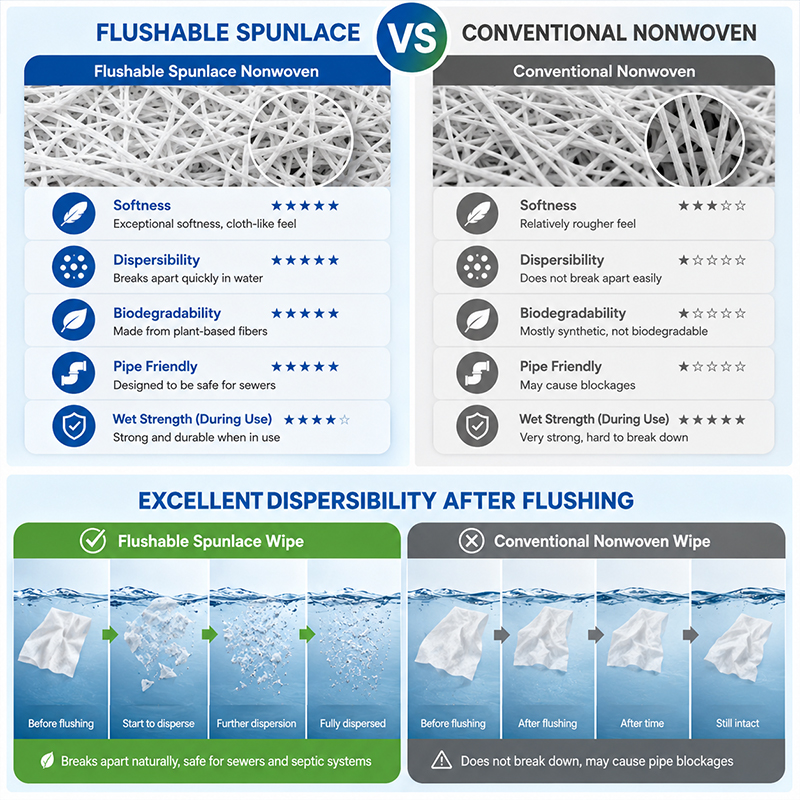
The main issue is that wet wipes are designed to retain their structure during use. Many products contain fiber networks or bonding structures that do not break apart as readily as toilet paper.
When wipes enter a drainage system, they may become entangled with other materials, accumulate around pumps, or contribute to blockages. Problems can occur in household pipes, municipal sewers, and wastewater infrastructure.
2.1 Wet wipes do not behave like toilet paper
Toilet paper is specifically manufactured to disperse in water under ordinary flushing conditions. Wet wipes have different material structures and are often designed to withstand repeated handling while wet.
| Property | Toilet Paper | Conventional Wet Wipes |
|---|---|---|
| Main design objective | Cleaning and rapid breakdown during flushing | Maintaining integrity during wet use |
| Typical fiber structure | Paper fibers designed to separate in water | Nonwoven fiber networks designed for handling strength |
| Wet strength | Generally decreases during contact with water | Often maintained to support wiping performance |
| Disintegration behavior | Designed to break apart during normal flushing and transport | May remain intact much longer, depending on the construction |
| Risk to drainage systems | Generally low when used correctly | Potentially higher if wipes accumulate in pipes or equipment |
The exact behavior depends on the product’s construction. This is why a wipe should not be assumed safe to flush simply because it looks thin, contains cellulose, or breaks apart when pulled by hand.
2.2 Wet wipes can contribute to sewer blockages
Wet wipes can become caught on rough surfaces, combine with grease and other debris, or accumulate around wastewater pumps. Over time, these materials may restrict water flow and increase maintenance requirements.
| Potential problem | How it happens | Possible consequence |
|---|---|---|
| Household pipe blockage | Wipes become trapped or accumulate in plumbing | Slow drainage, toilet backup, or plumbing repairs |
| Sewer obstruction | Wipes collect with grease and other waste | Restricted wastewater flow |
| Pump interference | Wipes become tangled around pump components | Equipment cleaning, maintenance, or operational disruption |
| Wastewater treatment challenges | Non-dispersed materials enter the wastewater system | Additional screening and solids-handling requirements |
| Increased maintenance costs | Blockages require inspection, removal, or repairs | Higher costs for households, businesses, or utilities |
These outcomes are not inevitable every time a wipe is flushed. However, repeated disposal of unsuitable wipes increases the potential for accumulation and infrastructure problems.
2.3 Flushable does not mean completely dissolvable
The word “flushable” is often misunderstood. A flushable wipe does not necessarily dissolve completely in water like a soluble substance.
Instead, flushability-related evaluations may examine whether the product breaks apart or disperses under specified conditions, along with other relevant performance criteria.
The following terms describe different properties:
| Term | What it means | What it does not automatically establish |
|---|---|---|
| Flushable | Designed and evaluated against relevant flushability criteria | Universal compatibility with every toilet, pipe, or wastewater system |
| Dispersible | Capable of separating or dispersing under defined conditions | Complete dissolution in water |
| Biodegradable | Capable of biological degradation under specified conditions | Suitability for flushing |
| Compostable | Meets applicable compostability requirements under defined conditions | Compatibility with sewer systems |
| Plastic-free | Makes a claim about plastic content under the applicable definition | Flushability or biodegradability |
A product may be biodegradable without being flushable. Likewise, a product’s flushability test results do not automatically prove that it is biodegradable or compostable.
3. How to Dispose of Different Types of Wet Wipes Correctly
The easiest way to avoid confusion is to match the disposal method to the product’s intended use.
3.1 Baby wipes
Baby wipes are designed for cleaning delicate skin and commonly use soft nonwoven substrates with a water-based lotion. They are generally intended for disposal in household waste, not through the toilet.
Recommended method: Put used baby wipes in a lined waste bin. If the wipe is heavily soiled, fold or wrap it before disposal and follow any applicable local waste instructions.
3.2 Makeup remover and facial wipes
Facial and makeup remover wipes may contain cleansing agents, emollients, or other formulation ingredients. Their substrate is usually designed to retain enough strength for effective wiping.
Recommended method: Dispose of used wipes in household waste. Do not assume that a thin or soft facial wipe will disperse in plumbing.
3.3 Disinfectant and household cleaning wipes
Disinfectant wipes and surface-cleaning wipes are developed for cleaning tasks rather than toilet disposal. Their formulations and substrates may be designed to withstand friction and maintain integrity during use.
Recommended method: Follow the package disposal instructions. Do not flush used cleaning wipes, even if the wipe appears small or lightweight. For wipes containing chemical ingredients, follow the manufacturer’s instructions and local waste requirements.
3.4 Pet wipes
Pet wipes are commonly used to clean paws, fur, and external body areas. Some products use thicker or textured substrates to improve dirt removal.
Recommended method: Place used pet wipes in household waste. Do not flush them together with pet waste unless local rules explicitly permit the particular disposal method.
3.5 Wet toilet tissue and products labeled flushable
Wet toilet tissue may be specifically developed to meet flushability-related performance requirements. However, local authorities do not all provide the same disposal recommendations.
Recommended method: Read the product instructions and check local wastewater guidance. If the local authority advises against flushing wipes, put the used product in household waste even if the package says “flushable.”

4. What Is the Difference Between Flushable Wet Wipes and Regular Wet Wipes?
The difference starts with product design and testing, not simply the marketing label.
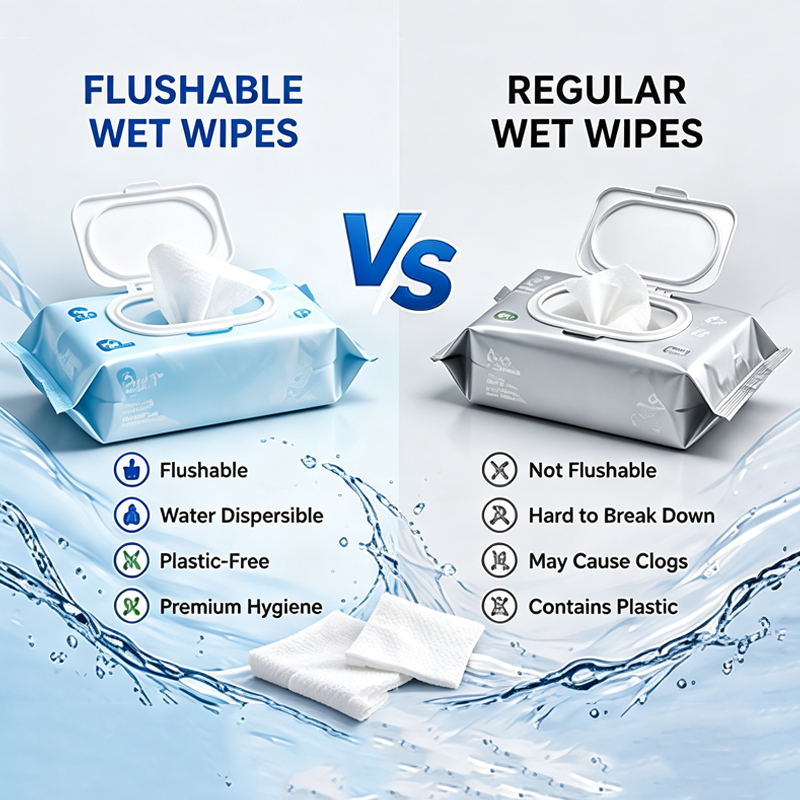
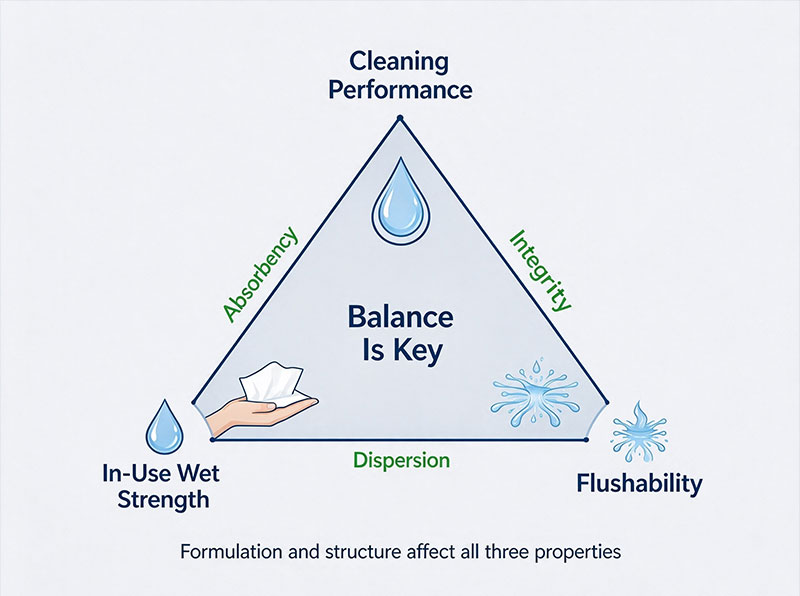
Conventional wet wipes are generally optimized for their intended cleaning application. Products developed for flushability need to balance adequate strength during use with appropriate dispersibility under the applicable evaluation conditions.
| Comparison factor | Flushable Wet Wipes | Regular Wet Wipes |
|---|---|---|
| Design objective | Balance wiping performance with flushability-related requirements | Meet the requirements of the intended cleaning application |
| Substrate selection | Selected for the intended product specification and performance claims | Selected for softness, strength, absorbency, cleaning, or other functional needs |
| Wet strength | Must be balanced with dispersibility performance | May prioritize durability during wet use |
| Testing | Relevant flushability testing may be required to substantiate claims | Product quality and application-specific testing |
| Disposal instructions | Depend on product labeling and local wastewater guidance | Generally household waste |
| Suitable applications | Products developed for toilet-area personal cleansing | Baby care, facial cleansing, household cleaning, pet care, and other uses |
A conventional wipe cannot be considered flushable merely because it contains plant-based fibers or has a low basis weight.
Similarly, the presence of a flushability-related test report does not mean that every product from the same manufacturer has identical performance. Product construction and specifications matter.
5. What Makes a Wet Wipe More Suitable for Flushability Development?
For manufacturers and product developers, flushability is a finished-product performance question. Raw materials are important, but no single fiber type guarantees a successful result.
Factors that influence product performance
| Factor | Role in the substrate | What manufacturers should evaluate |
|---|---|---|
| Fiber composition | Influences strength, softness, and absorbency | Whether the fiber combination suits the intended product and claim |
| Fiber length and distribution | Contribute to the nonwoven network | How the structure behaves during use and under relevant tests |
| Bonding structure | Holds fibers together | Whether the product maintains sufficient integrity during use and disperses as required |
| Basis weight (GSM) | Defines material mass per unit area | The balance between thickness, handling performance, and test results |
| Lotion formulation | Provides moisture and cleansing properties | Compatibility with the substrate and finished-product performance |
| Sheet size | Determines the dimensions of each wipe | Whether the finished specification aligns with the intended use and applicable evaluation |
| Manufacturing consistency | Helps maintain product specifications | Whether production batches remain consistent with the tested product |
Wood pulp and other cellulose-based fibers may be considered in flushable wipe development because of their absorbency and fiber characteristics. However, the finished product’s performance depends on the entire material construction and manufacturing process.
For this reason, manufacturers should avoid relying on claims such as “natural fiber,” “biodegradable material,” or “cellulose-based substrate” as standalone evidence of flushability.
Why testing matters
Depending on the intended market and the claim being made, manufacturers and buyers may review applicable flushability guidelines, dispersibility testing, drainline transport evaluations, and other relevant test evidence.
When reviewing a supplier’s report, confirm:
- The identity and specification of the tested product.
- The test method and acceptance criteria.
- The laboratory and report date.
- Whether the report covers the finished wipe or only the raw material.
- Whether the commercial product matches the tested substrate, lotion, dimensions, and construction.
A report should be interpreted within its stated scope. It should not be presented as universal approval for every product or every wastewater system.

6. How Consumers Can Reduce Wet Wipe Disposal Problems
Correct disposal is straightforward when a few habits are followed consistently.
| Good practice | Why it helps |
|---|---|
| Keep a small covered waste bin in the bathroom | Makes correct disposal convenient |
| Read the product label before use | Helps clarify intended use and disposal instructions |
| Follow local wastewater authority recommendations | Accounts for local plumbing and sewer-system requirements |
| Avoid flushing baby wipes, facial wipes, and cleaning wipes | Reduces the chance of unsuitable materials entering drains |
| Do not rely on appearance alone | Thin or soft wipes may still retain their structure in water |
| Do not flush multiple wipes together | Avoids introducing unnecessary nonwoven material into the plumbing system |
| Teach household members and guests about disposal | Helps prevent accidental flushing |
A bathroom bin with a liner is a simple, practical solution for most used wipes. Where hygiene is a concern, choose a suitable covered bin and empty it regularly.

7. What Should Retailers and Wet Wipes Brands Know About Disposal Labels?
For importers, retailers, and private label brands, disposal instructions are part of responsible product communication.
A product label should accurately reflect the product’s intended use, the evidence supporting its claims, and the applicable requirements in the destination market.
| Label or marketing claim | What should be verified before use |
|---|---|
| “Flushable” | Evidence supporting the specific claim, plus applicable labeling and market requirements |
| “Biodegradable” | Relevant test evidence, the conditions of degradation, and the scope of the claim |
| “Plastic-free” | Material composition and the definition used for the claim |
| “Safe for septic systems” | Evidence appropriate to the product and the specific claim |
| “Dispersible” | The applicable test method and conditions |
| “Eco-friendly” | Clear, specific, substantiated environmental benefits rather than a vague general claim |
Avoid suggesting that a wipe can be flushed everywhere or that it is guaranteed not to cause blockages. Such claims can overstate what a test report demonstrates.
For international products, disposal instructions should be reviewed for the intended country or region. Wastewater guidance and product-labeling requirements may differ between markets.
8. Frequently Asked Questions About Wet Wipe Disposal
Can you flush wet wipes labeled “flushable”?
Not necessarily. Some wipes are designed and tested for flushability-related performance, but wastewater authorities may still advise consumers not to flush them. Follow local guidance and the product instructions.
Why can’t you flush baby wipes?
Baby wipes are generally designed to remain intact during wet use. They may not break apart quickly enough in plumbing and can contribute to blockages when they accumulate with other materials.
Do flushable wipes dissolve in water?
Not necessarily. Flushability generally concerns performance under defined conditions, including dispersibility, rather than complete dissolution.
Are biodegradable wet wipes safe to flush?
No automatic conclusion can be made from a biodegradable claim. Biodegradability and flushability are different properties, and the finished product needs appropriate evidence for each claim.
Can wet wipes clog toilets?
Yes. Wet wipes can become trapped in pipes or accumulate with other debris, potentially contributing to blockages and wastewater equipment problems.
What is the best way to dispose of used wet wipes?
For most baby wipes, facial wipes, household cleaning wipes, pet wipes, and other conventional wet wipes, household waste is the recommended general option. Follow product-specific and local waste instructions.
Can you flush wet toilet tissue?
Check the package instructions and local wastewater guidance. Even when a product is labeled flushable, some wastewater authorities recommend putting all wipes in the trash.
Are flushable wet wipes the same as toilet paper?
No. Toilet paper is designed to disperse during ordinary flushing, while wet wipes are engineered to retain strength during wet use. Their behavior in plumbing systems is not necessarily the same.
How can a buyer verify a manufacturer’s flushability claims?
Ask for the product specification and relevant test reports. Check the tested product, test method, acceptance criteria, and whether the report matches the finished product being purchased.

9. Final Thoughts: Dispose of Wet Wipes Responsibly
Wet wipes offer convenience in personal hygiene, baby care, facial cleansing, household cleaning, and bathroom care. However, their convenience should not come at the expense of plumbing systems and wastewater infrastructure.
The most important rule is simple: do not assume that every wet wipe can be flushed. Conventional wipes should generally be placed in household waste, while products marketed as flushable should be evaluated according to their actual evidence, product instructions, and local wastewater guidance.
For manufacturers and private label brands, responsible product development involves more than choosing a substrate. It requires suitable material design, consistent manufacturing, accurate performance claims, and clear disposal instructions.
By understanding the differences between flushable, biodegradable, and conventional wet wipes, consumers can make better disposal decisions, while brands and manufacturers can provide more transparent product information.
For additional information about nonwoven substrates, flushability-related product testing, and wet wipes manufacturing, consult relevant industry guidelines and your local wastewater authority.
Post time: Oct-28-2026