Flushable wet wipes have become an important product category in personal hygiene and bathroom care. Compared with traditional dry toilet paper, they offer a moist, convenient cleaning experience. However, not all wet wipes are designed to be flushed, and a product labeled “flushable” should not be assumed to be suitable for every plumbing or wastewater system.
For retailers, importers, distributors, and private label brands, understanding flushable wet wipes requires more than comparing price and packaging. Material composition, wet strength, dispersibility, lotion formulation, testing methods, and local disposal guidance all influence product selection.
This guide explains what flushable wet wipes are, how their materials differ from conventional wipes, which testing considerations matter, and how to evaluate a reliable flushable wet wipes manufacturer.

1. What Are Flushable Wet Wipes?
Flushable wet wipes are pre-moistened wipes specifically designed to meet defined flushability performance criteria. They are commonly used for personal cleansing after using the toilet and are often marketed as an alternative or complement to dry toilet paper.
The key difference between flushable wipes and ordinary wet wipes is not simply how quickly the material becomes wet or whether it contains plant-based fibers. The finished product must be evaluated for its ability to break apart and disperse under specified test conditions, together with other relevant performance and safety considerations.
| Feature | Flushable Wet Wipes | Conventional Wet Wipes |
|---|---|---|
| Primary purpose | Toilet-area personal cleansing | Baby care, facial care, household cleaning, personal care, and other uses |
| Material design | Designed to meet applicable flushability criteria | Designed primarily for its intended cleaning application |
| Wet strength | Balanced with the required dispersibility performance | May prioritize durability during use |
| Disposal method | Follow product instructions and local wastewater guidance | Usually dispose of in a waste bin unless the product is specifically verified and labeled for flushing |
| Common formats | Individually wrapped sachets, soft packs, resealable packs | Soft packs, canisters, tubs, sachets, and bulk formats |
| Key purchasing consideration | Verified flushability performance and appropriate labeling | Cleaning performance, durability, skin compatibility, and cost |
Important: A wipe that is biodegradable, compostable, or made from plant-based fibers is not automatically flushable. These terms describe different product characteristics and should not be used interchangeably.
2. What Materials Are Used in Flushable Wet Wipes?
The substrate is one of the most important factors in flushable wet wipes manufacturing. It affects softness, absorbency, wet strength, thickness, and how the wipe behaves during dispersibility testing.
Depending on the intended market and product specification, manufacturers may evaluate cellulose-based fibers, viscose, wood-pulp blends, or other suitable nonwoven constructions.
Common substrate materials compared
| Material | Typical characteristics | Potential advantages | Points to evaluate |
|---|---|---|---|
| Wood pulp / cellulose fibers | Plant-derived cellulosic fibers | Absorbency and compatibility with certain dispersible nonwoven designs | Fiber bonding, wet integrity, and finished-product test results |
| Viscose / regenerated cellulose | Soft, absorbent regenerated cellulose fiber | Comfortable hand feel and good liquid absorption | Fiber structure, processing method, and dispersibility |
| Wood pulp and synthetic fiber blends | Composite construction using cellulose and synthetic fibers | Can be engineered for strength and handling | Synthetic fiber content may affect disintegration behavior and should be assessed through testing |
| Other cellulose-based nonwoven constructions | Fiber combinations and structures developed for specific requirements | Flexibility in product design | Suitability must be confirmed for the exact construction and intended claim |
The material name alone cannot prove flushability. Two wipes made with similar fiber types can behave differently because of fiber length, bonding structure, basis weight, hydroentanglement conditions, additives, and the complete finished-product construction.
Why is wood pulp commonly considered for flushable wipe development?
Wood pulp is a cellulose-based raw material valued for its absorbency. In suitable nonwoven constructions, cellulose fibers can contribute to the development of wipes designed to disperse under defined conditions.
However, adding wood pulp to a substrate does not automatically make the wipe flushable. A manufacturer should evaluate the finished wipe rather than rely solely on the raw material description.
For product developers, the objective is to balance three requirements:
- Cleaning performance: The wipe should provide adequate moisture and effective personal cleansing.
- Use performance: The substrate should remain intact during dispensing and normal wiping.
- Flushability performance: The finished product should meet the applicable criteria for its intended claim and market.
3. Flushable Wet Wipes vs. Regular Wet Wipes
One of the most important distinctions for buyers is the difference between a wipe designed to disperse and one designed to remain strong during use.
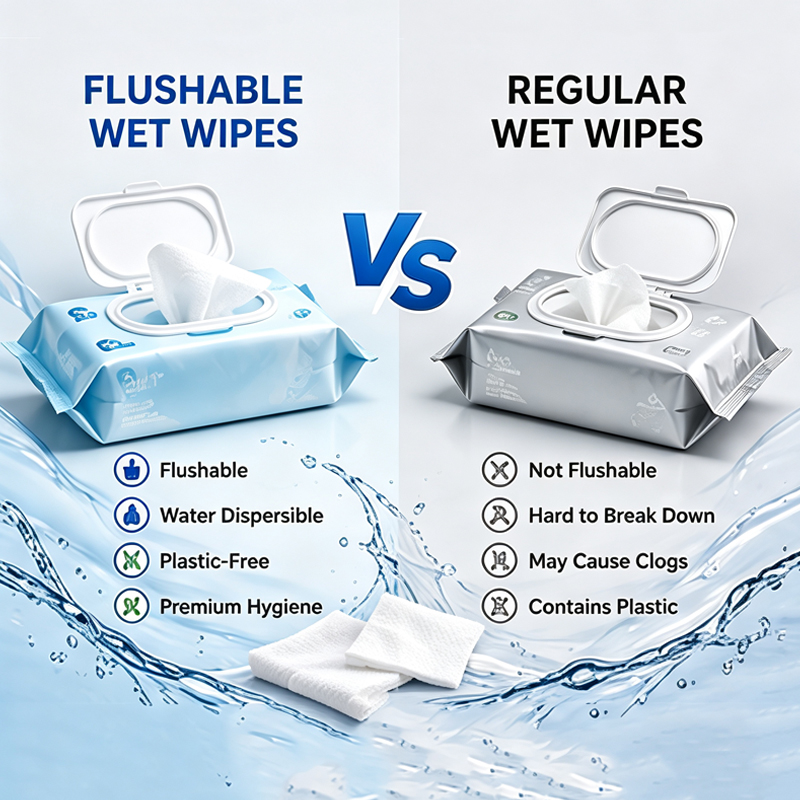
| Comparison factor | Flushable Wet Wipes | Regular Wet Wipes |
|---|---|---|
| Substrate design objective | Balance use strength with dispersibility | Prioritize the performance required for the specific application |
| Fiber selection | Selected and engineered for the intended flushability claim | May include durable synthetic fibers or stronger composite structures |
| Bonding and structure | Evaluated for performance during use and under specified disintegration conditions | Often designed to maintain integrity throughout cleaning |
| Testing focus | Applicable flushability tests plus product quality and safety checks | Relevant quality, performance, and safety tests |
| Marketing claim | Requires appropriate evidence for the exact claim | Should accurately reflect the intended use |
| Disposal instructions | Must follow label instructions and local wastewater guidance | Generally placed in a waste bin unless explicitly supported otherwise |
A regular baby wipe, makeup wipe, or household cleaning wipe should not be treated as flushable merely because it is thin or breaks apart when pulled by hand.
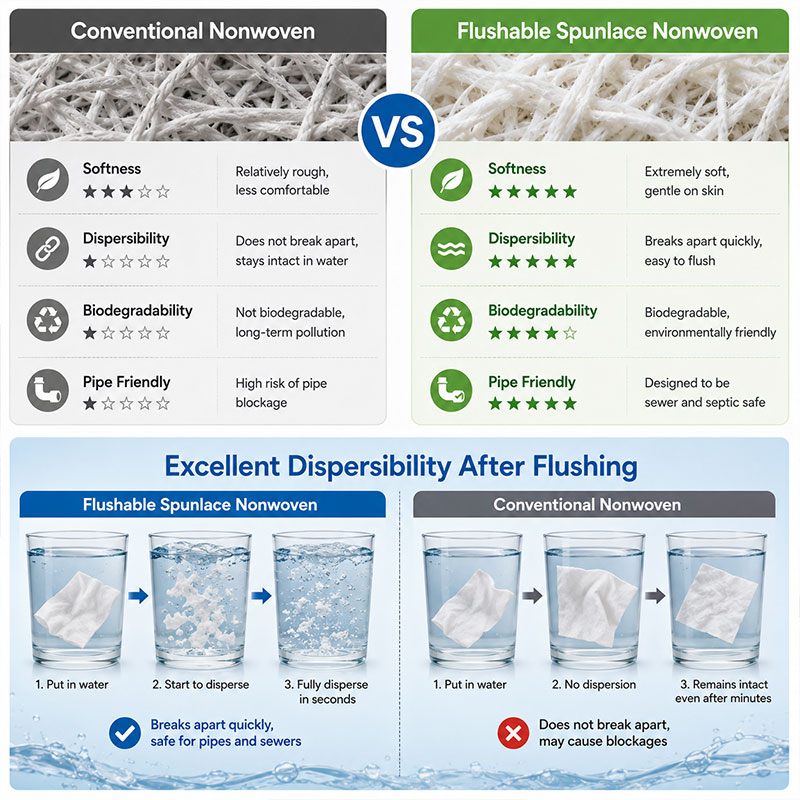
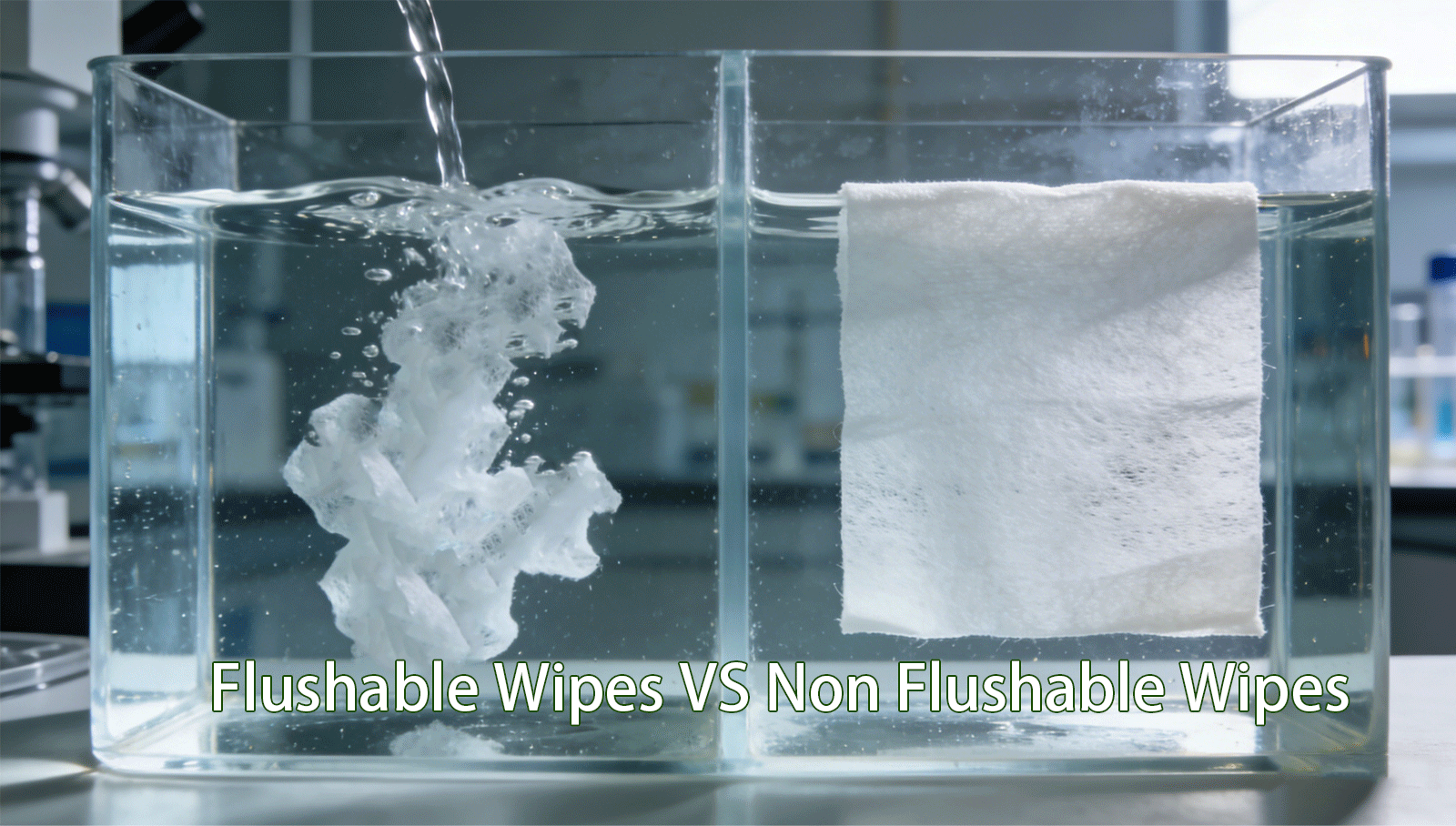
Similarly, a flushable wipe does not necessarily dissolve completely in water. Flushability performance involves how the material disperses under defined conditions, not simply whether it dissolves.
4. How Do Flushable Wet Wipes Work?
Flushable wipes are designed to provide sufficient strength during normal use while allowing the substrate to break apart under appropriate test conditions.
The development process typically considers several interacting factors.
| Design factor | Function in the product | Why it matters |
|---|---|---|
| Fiber composition | Determines key substrate properties | Influences absorbency, softness, strength, and dispersibility |
| Fiber length and distribution | Affect the web structure | Can influence the way the substrate separates |
| Bonding structure | Holds fibers together | Must provide suitable use strength without undermining the intended dispersibility |
| Basis weight (GSM) | Controls material mass per unit area | Affects thickness, hand feel, absorbency, and structural performance |
| Lotion loading | Provides moisture and cleansing properties | Can affect the handling and overall behavior of the finished wipe |
| Sheet size and folding | Defines the individual wipe format | Influences dispensing, use, and the amount of material entering the plumbing system |
No single factor determines the final result. A thinner wipe is not automatically more flushable, and a cellulose-rich wipe is not automatically suitable for flushing. Performance should be verified on the finished product using relevant testing methods.
5. Flushability Standards and Testing: What Should Buyers Know?
For manufacturers and international buyers, flushability claims should be supported by documented testing rather than general descriptions such as “eco-friendly,” “natural,” or “made with cellulose.”
Two important references in this area are the International Water Services Flushability Group (IWSFG) guidelines and the EDANA/INDA flushability guidance framework. Buyers should verify the current edition, applicable test requirements, and the specific claim being made before using any standard in marketing or product documentation.
Key flushability testing considerations
| Test or assessment area | What it evaluates | Why it matters to buyers |
|---|---|---|
| Dispersibility / disintegration | How the wipe breaks apart under defined conditions | Helps assess whether the material behaves as intended during flushing-related testing |
| Slosh-box or comparable test methods, where applicable | Behavior under specified agitation and test conditions | Provides evidence about material breakdown under the chosen protocol |
| Drainline transport | Movement through a defined simulated drainage system | Helps evaluate transport performance under test conditions |
| Sewer-system interaction | Potential interactions with wastewater infrastructure under relevant evaluation methods | Supports a broader understanding of flushing-related performance |
| Product quality testing | Dimensions, basis weight, tensile properties, moisture content, and other specifications | Helps maintain consistent product quality between production batches |
| Lotion and microbiological quality assessments | Relevant formulation and finished-product quality attributes | Supports the product’s intended use and market requirements |
The table is a purchasing overview, not a claim that every listed test is mandatory under every framework. Applicable requirements depend on the chosen standard, the product, and the intended market.

IWSFG GD4 and flushability claims
IWSFG GD4 is a relevant guideline reference for buyers evaluating flushability-related product claims. When a supplier presents an IWSFG GD4-related test report, buyers should check the document carefully to understand:
- The exact product or substrate tested.
- The testing laboratory and report date.
- The test methods and acceptance criteria used.
- Whether the report applies to the finished wipe or only to a raw material.
- Whether the marketed product matches the tested formulation, dimensions, basis weight, and construction.
A test report should not be interpreted as blanket approval for all products from a supplier. A change in substrate, formulation, dimensions, or manufacturing process may require further evaluation.
In addition, local wastewater authorities may recommend that consumers avoid flushing wipes, even when they are labeled flushable. Product labeling and consumer guidance should therefore be checked for the target market.

6. Flushable vs. Biodegradable vs. Compostable Wet Wipes
These terms are often confused in the wipes industry. For buyers developing new products, distinguishing them is essential for accurate claims and responsible product positioning.
| Term | Main meaning | What it does not automatically prove |
|---|---|---|
| Flushable | Designed and evaluated against relevant flushability criteria | That the product is biodegradable in every environment or safe for every plumbing system |
| Biodegradable | Capable of biological degradation under specified conditions | That the product will disperse sufficiently for flushing |
| Compostable | Designed to meet specified compostability requirements under defined conditions | That the product is suitable for disposal through a toilet |
| Plastic-free | Claims that the product contains no plastic, subject to the exact definition and evidence used | That the product is automatically flushable or compostable |
| Cellulose-based | Uses cellulose fibers as a material component | That the finished wipe meets any particular flushability standard |
For example, a wipe may contain plant-derived fibers but still have a bonding structure that prevents it from dispersing as required. Conversely, flushability performance alone does not establish that a product meets a compostability certification.
Buyers should request evidence that corresponds to each individual claim rather than relying on a single general sustainability statement.
7. How to Choose the Right Flushable Wet Wipes
The right specification depends on the intended customer, market, price positioning, packaging format, and performance requirements.
Product selection checklist
| Purchasing factor | Questions to ask a manufacturer |
|---|---|
| Target market | Which country or region will the product be sold in? |
| Intended use | Is it designed for adult personal hygiene, bathroom care, or another clearly defined use? |
| Substrate | What fiber composition and nonwoven structure are proposed? |
| Basis weight | Which GSM options are available, and how do they affect softness and durability? |
| Sheet dimensions | What wipe sizes and folding formats are available? |
| Lotion formula | Can the moisture level, ingredients, fragrance, and other formulation details be customized? |
| Flushability evidence | Which applicable test methods were used, and is the report for the exact finished product? |
| Packaging | Are soft packs, resealable packs, or individually wrapped wipes available? |
| Private labeling | Can the supplier customize artwork, packaging, carton specifications, and product presentation? |
| Quality control | How are incoming materials, production batches, and finished goods checked? |
| Regulatory support | Can the supplier provide the technical documents required for the target market? |
| Sampling | Can buyers evaluate samples before confirming bulk production? |
Why GSM matters
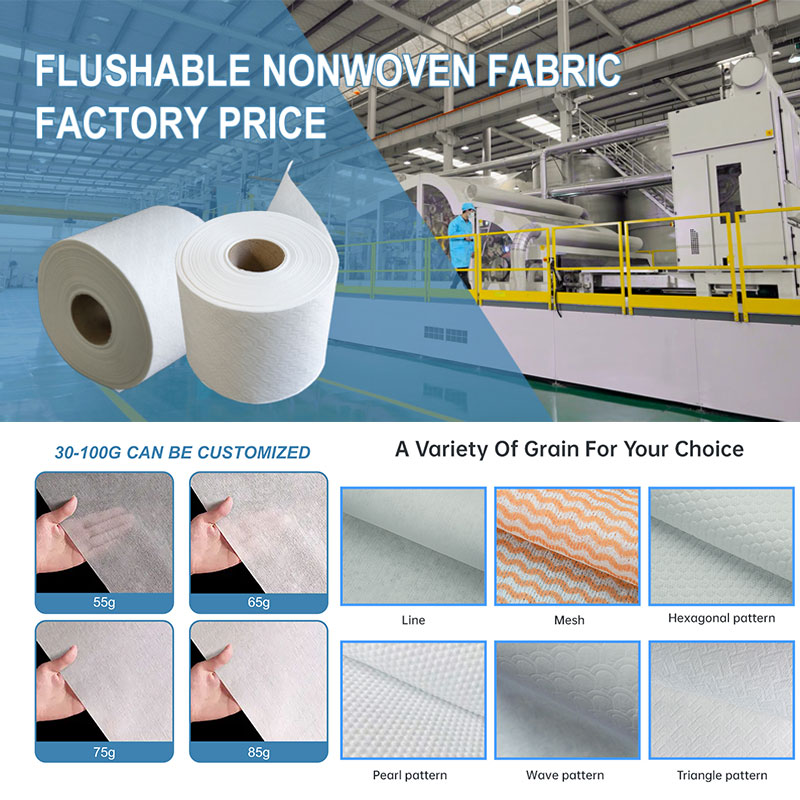
GSM means grams per square meter and is a standard way to describe the basis weight of a nonwoven substrate. It is useful for comparing material specifications, but it is not a standalone indicator of product quality or flushability.
| GSM consideration | Potential impact |
|---|---|
| Lower basis weight | May reduce material usage, but must still provide adequate handling and cleaning performance |
| Higher basis weight | May create a thicker or more substantial hand feel, depending on the fiber structure |
| Fiber composition | Can change strength and softness even at the same GSM |
| Bonding method | Can affect wet integrity and dispersibility independently of basis weight |
| Finished wipe design | Sheet size, folding, lotion loading, and packaging all contribute to the final user experience |
There is no universal GSM that makes a wipe flushable. The appropriate specification should be established through product development and finished-product testing.
8. OEM and Private Label Flushable Wet Wipes
For retailers, brand owners, importers, and distributors, working with an OEM or private label manufacturer can provide flexibility in product design and packaging.
A suitable supplier should be able to discuss the relationship between the substrate, lotion, finished-wipe performance, testing evidence, and the requirements of the intended market.
Common customization options
| Customization area | Possible options |
|---|---|
| Substrate material | Cellulose-based fibers and other suitable nonwoven constructions |
| Basis weight | Developed according to target performance and product requirements |
| Sheet size | Customized length and width |
| Folding format | Designed for the selected pack and dispensing system |
| Lotion | Customized moisture level and formulation, subject to feasibility and applicable requirements |
| Packaging | Soft packs, resealable packs, individually wrapped sachets, and other suitable formats |
| Branding | Private label printing, packaging artwork, and carton customization |
| Quality documentation | Product specifications, batch records, and relevant test reports, as applicable |
What to confirm before placing an OEM order
- Request a clear product specification. Confirm fiber composition, GSM, dimensions, lotion details, packaging, and tolerances.
- Review the test evidence. Ensure that the test report identifies the relevant product and matches the proposed specification.
- Approve production samples. Evaluate softness, strength during use, moisture distribution, dispensing, and packaging performance.
- Confirm labeling requirements. Check the wording permitted in the target market and the appropriate disposal instructions.
- Agree on quality controls. Establish inspection criteria, batch consistency expectations, packaging checks, and procedures for specification changes.
A reliable manufacturer should explain what has actually been tested, what can be customized, and which claims require additional verification.
9. Common Questions About Flushable Wet Wipes
Are flushable wet wipes really flushable?
Flushable wet wipes are designed to meet defined flushability criteria, but performance depends on the exact product and the applicable test method. Follow the package instructions and local wastewater guidance. A flushable label should not be interpreted as permission to flush unlimited quantities.
Do flushable wet wipes dissolve in water?
Not necessarily. Flushable wipes are generally evaluated for their ability to break apart or disperse under specified conditions. This is different from completely dissolving in water.
Are all biodegradable wet wipes flushable?
No. Biodegradability and flushability are different properties. A biodegradable wipe may not disperse adequately in plumbing or wastewater-related tests.
What is the difference between flushable wipes and toilet paper?
Toilet paper is designed to break down in water during ordinary use in sanitation systems. Flushable wipes are engineered to provide a moist cleaning experience while meeting relevant flushability criteria. Their performance is not necessarily identical to toilet paper, and local disposal guidance remains important.
Which materials are suitable for flushable wet wipes?
Suitable materials depend on the intended specification and the results of finished-product testing. Cellulose-based fibers and selected nonwoven constructions may be considered, but the material name alone does not demonstrate flushability.
What is IWSFG GD4?
IWSFG GD4 is a guideline reference associated with flushability evaluation. Buyers should confirm the current document, applicable test requirements, and the scope of any supplier report before making product claims.
Can flushable wet wipes be customized for private label brands?
Yes, customization may include substrate construction, GSM, sheet size, lotion, folding, packaging, and branding. However, changes to the product may affect its performance and may require additional testing before the same flushability claim can be retained.
How can buyers verify a flushable wet wipes supplier?
Request a detailed specification, relevant finished-product test reports, sample products, quality-control information, and documentation appropriate to the destination market. Confirm that the tested product matches the commercial product being offered.
Can flushable wet wipes be flushed in every toilet?
No universal guarantee applies to every plumbing or wastewater system. Consumers should follow local wastewater authority recommendations and product instructions. Some authorities advise against flushing wipes because of potential blockages and infrastructure impacts.
10. Final Thoughts: Choosing Flushable Wet Wipes with Confidence
Choosing flushable wet wipes involves more than selecting a substrate or finding the lowest unit price. Fiber composition, web construction, GSM, lotion formulation, finished-product performance, test evidence, packaging, and market-specific labeling all deserve attention.
For businesses developing a new product or sourcing private label flushable wet wipes, the most reliable approach is to define the target specification first, evaluate relevant test reports, and approve samples before mass production.
Looking for a flushable wet wipes OEM or private label partner? Discuss your target market, substrate preferences, packaging format, and documentation requirements with a manufacturer that can explain its product specifications and available test evidence. This helps you develop a product that aligns with your brand positioning and the requirements of your intended market.
Post time: Oct-27-2026